
A Strategic Guide to Content Creation for Marketing Agencies
Content creation for marketing agencies requires balancing high editorial standards with repeatable operational systems across multiple client accounts. Delivering consistent search performance for dozens of clients simultaneously fails when teams rely entirely on fragmented manual processes. To protect profit margins and drive organic client growth, agencies must treat content creation as a structured production discipline spanning audience research, topic discovery, drafting, search engine optimization, and distribution.
Defining Digital Content Creation for Agency Portfolios
In an agency environment, content creation is the end-to-end process of producing digital assets that fulfill search intent, establish topical authority, and generate commercial pipeline for diverse client brands. Unlike an in-house marketing team that focuses on a single industry and tone of voice, an agency must manage disparate audience profiles, technical stacks, and competitive landscapes at the same time.
A comprehensive agency content program combines five core disciplines:
Market and competitor research: Evaluating the search landscape to identify topical gaps and high-intent keyword opportunities within the client's industry.
Audience modeling: Aligning content angles with the specific pain points, industry vocabulary, and buying stages of target decision-makers.
Copywriting and editorial development: Generating substantive, accurate copy that reflects the distinct brand strategy and positioning of each client account.
Asset integration: Adding relevant imagery, diagrams, and data tables to improve readability and visual engagement.
Technical search optimization: Structuring headings, metadata, schema markup, and internal linking paths so search crawlers and AI answer engines can parse and index the material effectively.
Why Systematic Content Creation Drives Organic Client Growth
Search engines reward topical authority built through comprehensive, regular publishing rather than sporadic output. Industry analysis from Market.us shows the global digital content creation market is projected to expand at a compound annual growth rate of 12.8%, reflecting the ongoing commercial demand for digital publishing capabilities.
Academic research on creator operations published by Bryant University notes that long-term digital publishing success depends on operational consistency and structured audience alignment. When agencies publish sporadically, client websites struggle to maintain topical depth, which allows competitors targeting the same keyword clusters to capture organic rankings.
At the same time, craftsmanship remains non-negotiable. Survey findings published by Reboot Online show that 90% of marketers identify content creation, specifically writing and editing, as the most critical skill for content marketing success. Agencies that build reliable systems to deliver well-researched, properly edited articles gain a compounding competitive advantage for their clients.
The Core Workflow of Scalable Content Creation
To run multi-client production without operational chaos, agency teams must standardise each stage of production. Relying on ad-hoc writing routines leads to missed deadlines and uneven quality across accounts.
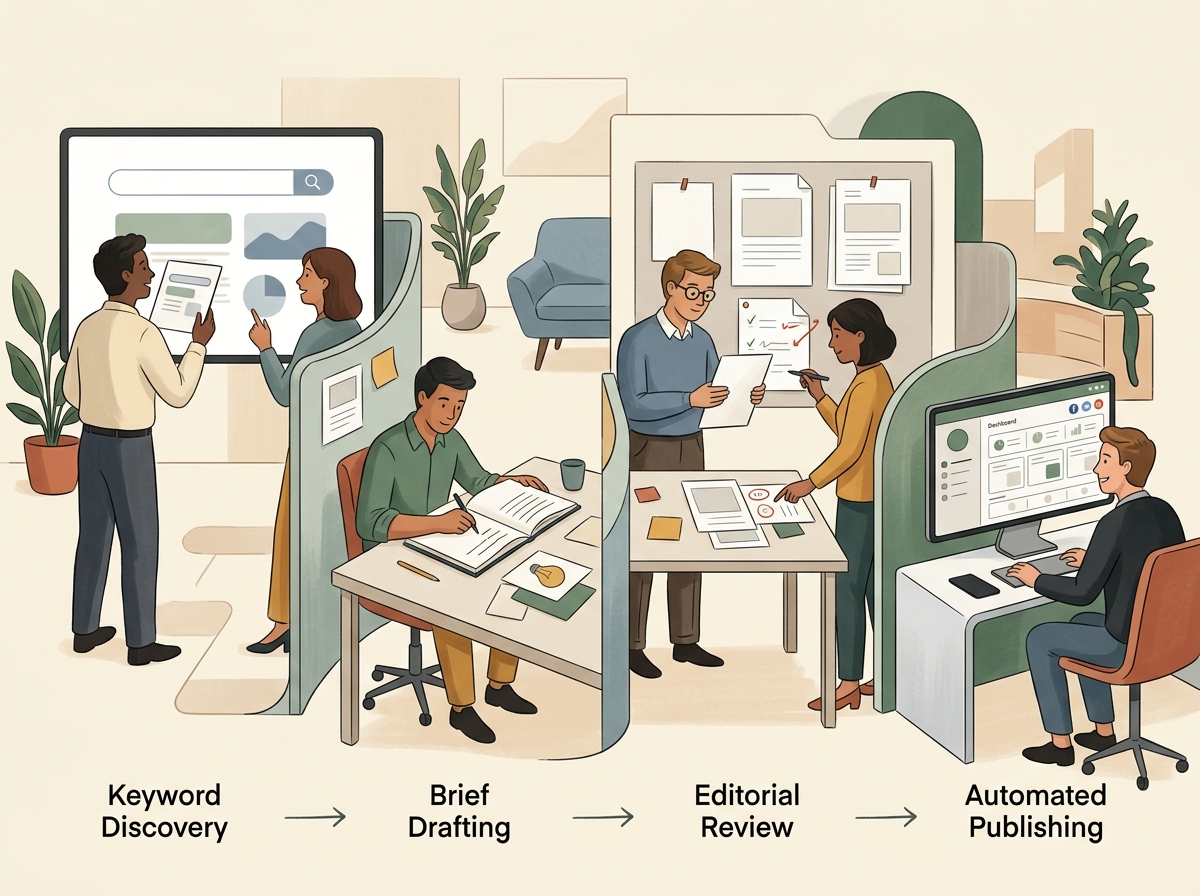
Keyword Discovery and Intent Mapping: Identify primary keywords, related semantic variations, and target search intents. Group queries into topical clusters rather than treating articles as isolated assets.
Brief Generation: Establish the exact heading structure, target word count, required entities, and internal link destinations before drafting starts. Clear briefs prevent revisions and keep external contributors, such as contract specialists or team members handling freelance writing assignments, aligned with account requirements.
Drafting and Voice Calibration: Write the body copy using clear, direct language. Avoid filler phrases, redundant introductions, and unverified claims.
Asset and Link Integration: Add original diagrams, contextual images, and links to relevant product pages or supporting blog posts to distribute link equity across the client domain.
Editorial Verification and Publishing: Review the draft for technical accuracy, formatting compliance, search metadata configuration, and CMS formatting before pushing the post live.
Managing Operational Bottlenecks and Quality Risks in Agency Production
Manual agency workflows hit severe operational limits as client rosters grow. Relying strictly on manual execution creates several predictable friction points:
Writer fatigue and burnout: Researching, outlining, writing, and formatting dozens of technical articles every week leads to diminishing editorial quality over time.
Voice inconsistency: When multiple writers contribute to a single client account, maintaining a cohesive tone across fifty or one hundred articles becomes difficult without extensive editorial oversight.
High cost per asset: Purely manual production requires significant billable hours for administrative tasks like keyword research, metadata drafting, and CMS uploads, squeezing agency profit margins.
Publishing latency: Multi-layer revision loops between writers, strategists, and clients frequently delay publishing schedules, stalling organic traffic momentum.
The table below highlights the operational differences between manual agency workflows and automated systems:
Comparison Criterion | Manual Agency Writing Workflows | AI-Automated Content Workflows |
|---|---|---|
Production Turnaround Time | Several days to two weeks per published piece, including drafting, editing, and CMS setup. | Minutes to generate complete drafts with metadata, requiring only a brief human editorial review. |
Editorial Consistency Across Accounts | Varies depending on assigned writers, client onboarding depth, and individual editor bandwidth. | Consistently maintains brand guidelines, preferred tone, and technical SEO structure across all accounts. |
Cost per Published Asset | High labor costs per article due to extensive hours spent on manual research, drafting, and formatting. | Low marginal cost per article, freeing agency budget for strategic consulting and technical client support. |
Keyword Coverage Scalability | Limited by team headcount and the physical number of hours writers can produce copy. | Capable of covering broad keyword clusters rapidly through automated 30-day editorial pipelines. |
Integrating AI Automation into Agency Content Creation Systems
Agencies are adopting AI automation to overcome production bottlenecks while protecting output quality. Industry research from Typeface indicates that nearly 94% of marketers plan to use AI for content creation to reduce the time required to produce each piece.

Implementing automated content creation does not mean removing human oversight. Modern automation platforms handle research, calendar generation, drafting, internal link insertion, and metadata creation. Human editors then review and refine the output within an AI-enhanced workspace, ensuring every published asset aligns with client positioning before going live.
This hybrid model allows agencies to publish daily, high-value articles across multiple client domains without hiring armies of contract writers. Search engines receive regular, topical content signals, while clients gain expanded keyword footprints and greater visibility across AI search systems.
Actionable Execution Steps for Agency Content Teams
To upgrade your agency content operations and scale production reliably, execute the following implementation plan:
Standardize Client Knowledge Profiles: Create a centralized profile for every client account detailing target personas, primary competitors, brand voice guidelines, product value propositions, and prohibited terminology.
Shift to 30-Day Keyword Calendars: Stop generating topics week by week. Build automated 30-day content roadmaps based on semantic keyword clusters to establish topical authority systematically.
Automate Routine Technical Steps: Use automation tools to generate meta titles, meta descriptions, image alt text, and contextual internal linking suggestions during the initial drafting phase.
Establish a Human-in-the-Loop Review Gate: Require a fast editorial pass before publication. Editors should verify factual claims, check client-specific nuances, and ensure formatting matches site styling.
Track Cluster-Level Search Performance: Measure performance across entire topic clusters rather than isolated articles. Track organic impressions, ranking velocity, and AI search citations to demonstrate tangible business value to clients.
Scaling content creation across diverse client portfolios requires reliable systems rather than unsustainable manual effort. Ascend automates your agency blog production by learning your clients' brands, researching high-intent keywords, building 30-day content calendars, and automatically drafting search-optimized articles complete with images, metadata, and internal links. Review each piece in an intuitive AI-assisted editor and deliver consistent organic search growth for every client on your roster.
Written by
Ascend
Ascend is an automated SEO engine for WordPress. It handles keyword research, writes high-quality, search-optimized content, and publishes it directly to your site, so your traffic can grow on autopilot. Learn more