
Guide to SEO Content Marketing for Marketing Agencies
SEO content marketing for marketing agencies is the systematic process of researching, producing, and optimizing editorial assets that satisfy user search intent while building long-term search engine authority for client domains. Instead of treating keyword optimization and editorial writing as separate services, an integrated strategy aligns editorial schedules with algorithmic search criteria to generate qualified inbound traffic.
What SEO Content Marketing Means for Modern Agencies
Traditional search engine optimization often focused on isolated technical fixes and keyword density targets. In contrast, modern search engines prioritize comprehensive answers, topical depth, and positive user engagement signals. For an agency, providing seo content marketing means developing content ecosystems that solve specific problems for a client's target audience at every stage of the buying journey.
According to data published by Forbes Advisor, 59% of B2C marketers state that high-quality content is their most effective SEO strategy. The broader industry reflects this demand, with projections cited by The Stacc showing global content marketing revenue reaching $107.5 billion by 2026. High search performance requires moving away from single-keyword blog posts toward structured topic clusters that demonstrate subject-matter expertise across an entire domain.
Integrating content strategy with rigorous technical SEO fundamentally transforms client deliverables from ephemeral traffic spikes into compounding digital equity. By establishing semantic relevance and structural integrity, agencies build durable assets that systematically capture hundreds of long-tail queries, earn high-authority external citations, and establish canonical presence within generative engines.
Why Integrated Search and Content Drives Client Retention
Client turnover in marketing agencies frequently happens when services fail to show predictable commercial value. Paid advertising channels deliver fast results, but traffic ceases immediately once the ad budget stops. Search-optimized content functions as a compounding asset that builds commercial value over time.
Research compiled by Typeface indicates that 61% of marketers are increasing their SEO spend. Agencies that establish predictable organic growth frameworks deliver three distinct advantages that protect retainer relationships:
Decreasing Customer Acquisition Costs: While initial production requires investment, evergreen content continues to attract organic visits without ongoing media spend, reducing blended acquisition costs month over month.
Compounding Domain Authority: High-performing editorial content earns backlinks and user engagement signals, which improves the organic ranking potential of the client's transactional and commercial pages.
Defensible Search Real Estate: Dominating high-intent search queries prevents direct competitors from capturing market share within that niche, solidifying the client's position as an industry leader.
Core Stages of an Effective SEO Content Marketing Workflow
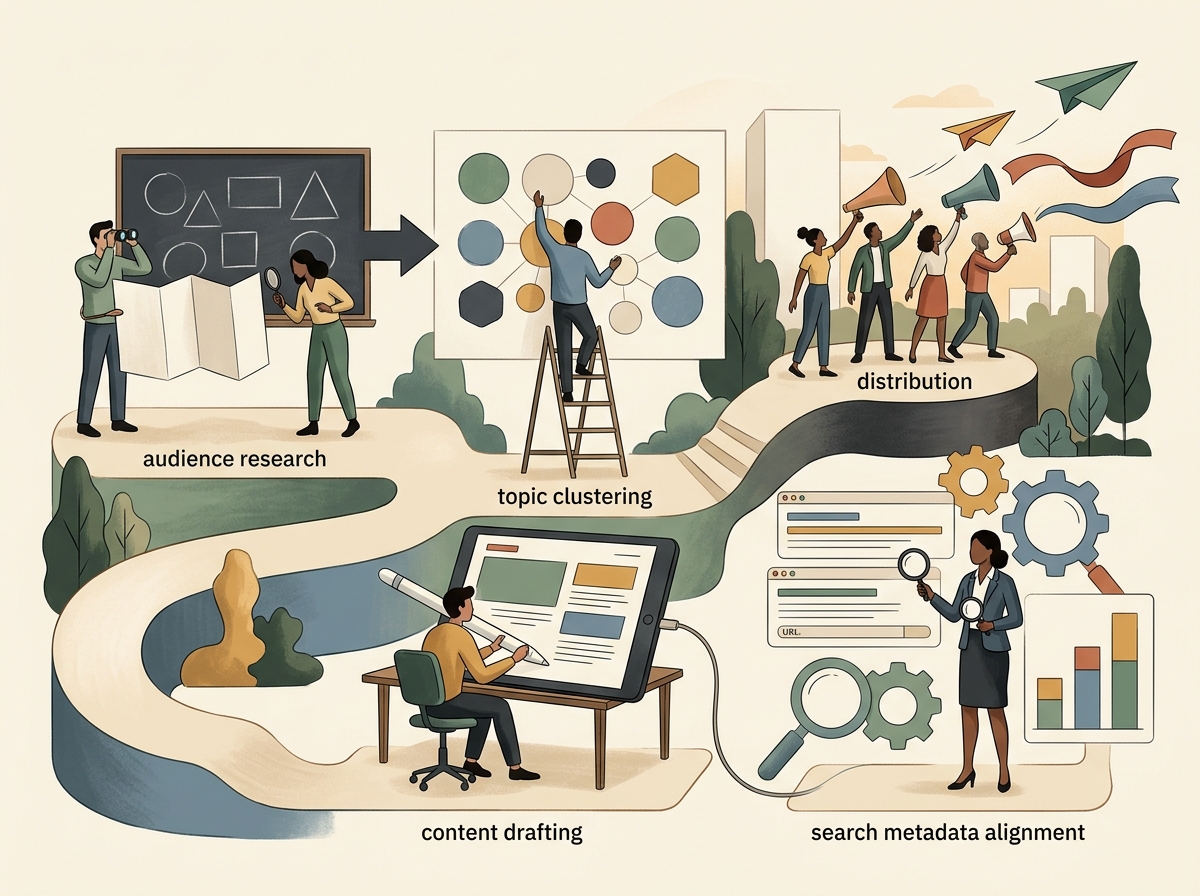
Scaling search performance across a client roster requires a repeatable production workflow. Relying on ad-hoc writing schedules leads to missed deadlines and disjointed content libraries.
1. Audience Research and Search Intent Mapping
Effective campaigns begin by identifying the precise problems, questions, and pain points of the client's buyers. Agencies must classify target search queries by intent (informational, commercial, navigational, or transactional) to ensure each article matches user expectations. For example, a B2B SaaS client selling logistics software benefits far more from informational queries like "how to optimize fleet routing workflows" at the top of the funnel and commercial comparison terms like "best enterprise fleet management platforms" near the decision stage than generic industry buzzwords.
2. Competitive Gap Analysis
Analyzing what ranking competitors have covered, and where their content falls short, exposes clear opportunities to win search share. Performing rigorous agency marketing competitive analysis allows your team to pinpoint neglected topics and target keywords with high search volume but weak existing search results. For instance, if competitor articles on a topic only offer surface-level checklists, your agency can capture the top ranking position by delivering in-depth workflows, original teardowns, and actionable downloadable templates.
3. Topic Cluster Architecture
Rather than producing disconnected articles, organize content into clear thematic hubs. A pillar page covers a broad subject comprehensively, while supporting cluster articles explore narrow subtopics in detail. This structural hierarchy helps search engines understand the thematic relevance of the client's domain. For example, a fintech client could anchor an exhaustive pillar page around "Corporate Treasury Management" linked bidirectionally to targeted cluster posts covering liquidity forecasting models, cross-border payment compliance, and cash concentration strategies.
4. Editorial Production and On-Page Optimization
Every article must deliver direct value quickly. Follow a clear process for creating effective SEO content, ensuring writers use clear heading structures, structured comparison tables, original examples, and relevant schema markup without sacrificing readability. Incorporating structured elements such as summary key takeaway callouts and FAQ schema also improves the chances of winning featured snippets and AI overview citations.
5. Strategic Internal Linking Networks
Connecting related blog posts through descriptive anchor text distributes page authority throughout the site. A disciplined internal linking structure guides visitors deeper into the conversion funnel and allows search engine crawlers to discover newly published pages faster. For example, embedding in-context links from high-traffic educational explainers directly into high-intent product comparison articles ensures organic equity and referral paths flow to bottom-of-funnel conversion pages.
Common Operational Bottlenecks in Manual Content Production
While the benefits of regular content publishing are evident, agencies face persistent operational barriers when attempting to manage production manually across multiple accounts.
Research and Briefing Overhead: Conducting keyword research, auditing competitors, and building detailed briefs takes multiple hours per article, restricting how many accounts an agency strategist can handle.
Writer Bandwidth and Expertise Gaps: Sourcing freelance or in-house writers who possess both subject-matter depth and technical SEO proficiency is costly and time-consuming.
Inconsistent Publishing Schedules: When agency teams get overwhelmed with other deliverables, publishing cadences drop. Gaps in publishing slow indexing and undermine search momentum.
Protracted Client Review Cycles: Without clear service level agreements (SLAs), client review delays stall production pipelines, preventing drafted content from going live and driving traffic.
Executing Scalable Search Content Strategies Across Client Portfolios
To scale content marketing across multiple accounts, agency leadership must separate strategic governance from routine production mechanics.

Maintaining brand voice across varied industries requires codified brand profiles. These documents should capture tone guidelines, target personas, preferred terminology, and unacceptable claims. When writers or automated tools reference these brand parameters, the resulting drafts require significantly fewer structural revisions.
Agencies must also transition from reactive weekly assignments to rolling 30-day editorial schedules. Establishing a full month of planned, keyword-mapped content in advance allows account managers to batch client reviews. To eliminate approval bottlenecks, institute asynchronous review windows where clients have a set window (such as 48 hours) to suggest factual edits before pieces are scheduled for publication.
Actionable Steps to Modernize Agency Content Operations
Implementing a modern content production engine requires concrete operational changes. Use this checklist to audit and upgrade your agency's content delivery model:
Audit Existing Client Content: Identify underperforming articles, keyword cannibalization issues, and pages that can be refreshed with new data or internal links.
Standardize Keyword and Cluster Briefs: Create unified briefing templates that include primary keywords, semantic entities, search intent classifications, and specific internal linking targets.
Establish Clear Review Protocols: Define exact criteria for client reviews, restricting feedback to technical accuracy and compliance to avoid endless stylistic rewrites.
Automate Recurring Research and Production: Deploy technology platforms to handle initial research, content calendar generation, metadata tagging, and draft creation, freeing your strategists to focus on campaign optimization and client communication.
Track Leading and Lagging Indicators: Measure intermediate signals like indexing speed, keyword footprint expansion, and average ranking positions alongside lagging metrics like organic traffic and lead conversions.
Scaling client content production no longer requires bloated editorial teams or endless manual research. Ascend fully automates blog content creation for agencies, analyzing client brands, building complete 30-day content calendars, and automatically publishing high-quality, search-optimized articles daily. Modernize your agency content workflow with Ascend today.
Written by
Ascend
Ascend is an automated SEO engine for WordPress. It handles keyword research, writes high-quality, search-optimized content, and publishes it directly to your site, so your traffic can grow on autopilot. Learn more