
How to Use IGCSE English Article Writing Examples to Craft Top-Mark Papers
Securing top marks in IGCSE English article writing requires breaking model responses down into specific structural components and replicating their persuasive mechanics under timed conditions. Rather than treating sample essays as static texts to memorize, successful candidates analyze how top-grade papers handle register, paragraph development, transitions, and examiner criteria. By dissecting high-scoring responses, you can master the exact conventions Cambridge and other examination boards demand.
Step 1: Deconstruct the Exam Prompt to Identify Audience and Format Requirements
Every article prompt in the IGCSE English exam contains explicit constraints that dictate your voice, register, and content choices. Misjudging the target reader is one of the most common reasons candidates lose marks in the reading and writing assessment objectives.
Before drafting your article, complete these four deconstruction checks:
Identify the publication channel: Determine whether the piece is intended for a school newsletter, a local community broadsheet, a youth-focused online magazine, or an international publication. A school paper requires a relatable, community-oriented style, whereas a local newspaper demands an objective, formal public tone.
Define the target readership: Pinpoint who will read the text. Are they fellow teenagers, headteachers, local government officials, or general members of the public? Your choice of idioms, rhetorical devices, and formality hinges on this distinction.
Clarify the primary purpose: Determine if your goal is to persuade, argue, inform, advise, or entertain. Most IGCSE prompts require a blend, such as informing readers about a problem while persuading them to adopt a specific remedy.
Establish the appropriate register: Choose a consistent tone. Writing for peers permits lively expressions and rhetorical questions, while addressing adults or local leaders requires an authoritative, measured approach without slang.
Step 2: Study Top-Mark IGCSE English Article Writing Examples for Core Structural Elements
Evaluating high-scoring IGCSE English article writing examples reveals that examiners look for purposeful layout choices rather than unbroken blocks of text. Model papers consistently utilize strong organizational tools to make arguments easy to navigate.
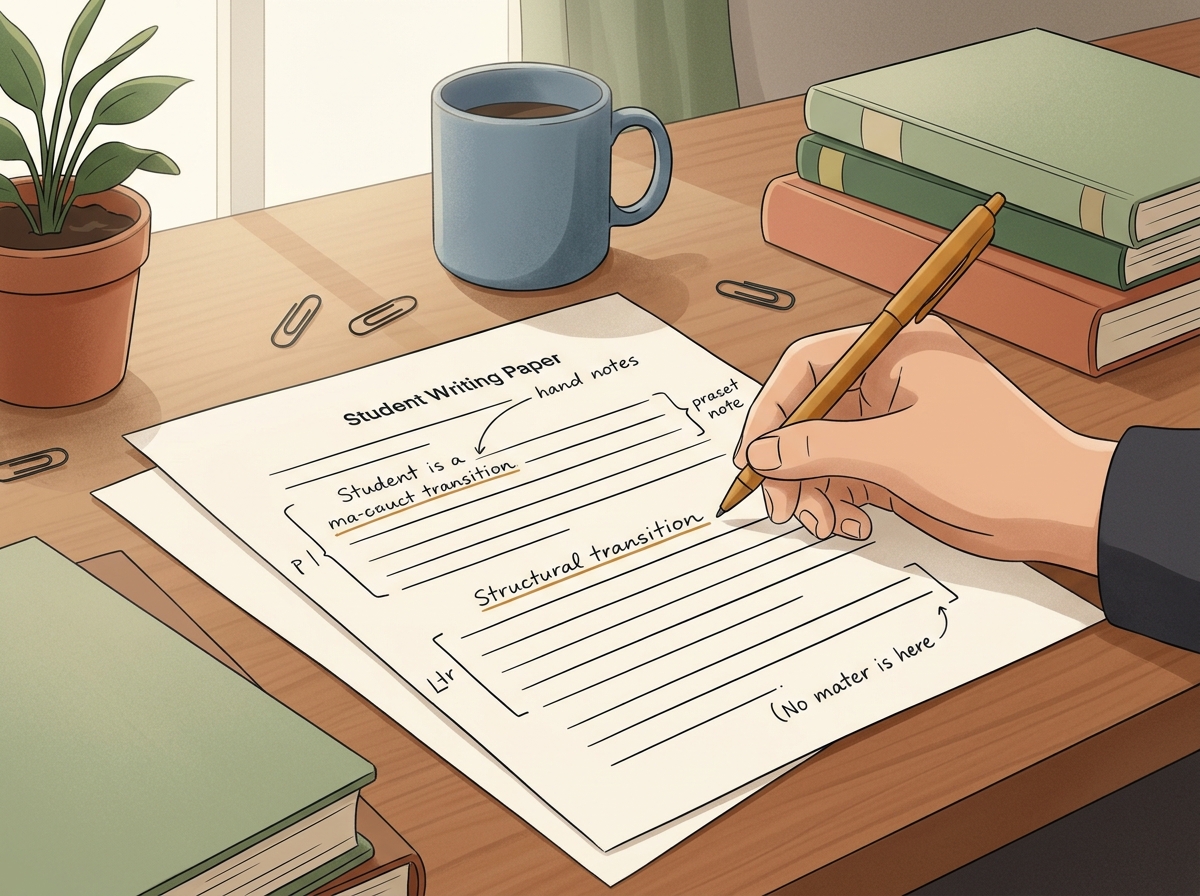
Structural Benchmarks of Band 1 Exemplars
When reviewing sample responses that earned top marks, pay attention to how authors balance structure and momentum. Top responses typically include:
A distinct, creative headline centered on the main contention.
Informative section headings that group arguments logically and keep the reader oriented. Studying practical sub heading examples can clarify how brief headings help divide long-form arguments into clear thematic units.
Topic sentences that introduce an argument directly instead of using generic transitional formulas.
Deliberate punctuation, including semicolons, colons for explanations, and question marks for rhetorical effect.
Deconstructing Lexical Precision
Model answers avoid vague adjectives and inflated vocabulary that obscures meaning. Instead, they rely on precise nouns and verbs that convey strong opinions concisely. As you analyze sample articles, note how candidates adjust their sentence length to build tension or emphasize key data. Practicing these techniques allows you to steadily improve your writing craft and gain confidence during timed assessments.
Step 3: Draft an Engaging Headline and Opening Hook to Establish Perspective
The first paragraph of your article must establish your viewpoint immediately so the examiner does not have to guess your position. A weak opening merely repeats the prompt; a top-mark opening frames the debate through a specific narrative or observational lens.
Start with a headline that informs and intrigues. Avoid basic labels such as "My Article on School Rules" or "Technology in Classrooms". Use active verbs or alliterative phrasing:
The Screen Time Paradox: Why Digital Learning Demands Digital Discipline
Beyond the School Bell: Rethinking the Modern Homework Routine
Community Spaces in Crisis: Why Our Local Parks Need Urgent Action
Follow the headline with an opening paragraph that uses one of three reliable hook methods:
The Micro-Scenario: Place the reader in a brief, descriptive scene that illustrates the broader topic in action.
The Paradoxical Observation: Highlight a contradiction in modern habits or institutional rules that demands resolution.
The Provocative Inquiry: Ask a direct, thoughtful question that challenges the reader's assumptions, then follow it with your thesis statement.
Step 4: Develop Cohesive Body Paragraphs Using Concrete Evidence and Varied Sentence Forms
Top-mark candidates dedicate each body paragraph to a single, well-developed argument. Rambling paragraphs that bundle multiple disconnected thoughts together confuse examiners and dilute persuasive power.

Follow this four-part structure to draft robust body paragraphs:
Lead with a direct assertion: Open the paragraph with an analytical topic sentence that advances your core thesis.
Provide concrete elaboration: Support your assertion with simulated real-world examples, localized scenarios, or hypothetical statistics that make the argument tangible.
Integrate and dismantle a counterargument: Address the opposing view directly to demonstrate analytical balance. Understanding what is rebuttal in writing helps you dismantle opposing perspectives fairly without undermining your primary argument.
Conclude with an outcome statement: End the paragraph by detailing the consequence of the point discussed, leading smoothly toward your next idea.
To keep the reading experience dynamic, vary your sentence structures across each paragraph. Balance compound sentences that coordinate parallel ideas with complex sentences that subordinate minor details to the main clause. Short, simple sentences placed after elaborate explanations provide strong rhetorical emphasis.
Step 5: Conclude with Actionable Recommendations to Leave a Lasting Impression
The conclusion must do more than summarize previous paragraphs. High-scoring IGCSE articles close by looking outward, providing readers with practical solutions or a clear call to action based on the points discussed.
Avoid ending with formulaic lines like "In conclusion, as I have stated above." Instead, adopt a forward-looking perspective using these three steps:
Synthesize without repeating: Rephrase your core argument using fresh terminology that reflects the evidence presented throughout the piece.
Offer concrete steps forward: Outline two or three realistic actions the target audience can take to solve the issue or improve the situation.
Deliver a definitive closing statement: Finish with a memorable final thought, an authoritative challenge, or a rhetorical question that prompts continued reflection.
Final Proofreading Checklist for Exam Conditions
Reserve five minutes at the end of the writing session to review your draft against these key criteria:
Audience and Tone: Did you maintain the chosen register from the headline through the final sentence without lapsing into inappropriate slang or excessive formality?
Visual Structure: Are paragraph breaks distinct, and did you include an informative headline and relevant subheadings?
Punctuation Variety: Did you incorporate a range of punctuation marks accurately while avoiding repetitive comma splices?
Direct Answering: Does every paragraph directly address the bullet points outlined in the exam question?
Producing regular, well-researched content requires reliable systems and clear editorial standards. Ascend helps teams scale their digital presence by fully automating keyword research, editorial calendar generation, and article creation. Learn how Ascend can streamline your organic content workflow and keep your publishing schedule consistent.
Written by
Ascend
Ascend is an automated SEO engine for WordPress. It handles keyword research, writes high-quality, search-optimized content, and publishes it directly to your site, so your traffic can grow on autopilot. Learn more