
6 High-Impact AI SEO Services Marketing Agencies Must Offer
Marketing agencies must expand their service catalogs beyond traditional keyword optimization to capture organic visibility inside generative search platforms. As searchers adopt conversational tools like ChatGPT, Claude, and Perplexity alongside conventional search engines, client discovery relies increasingly on how artificial intelligence systems synthesize information. Agencies that offer specialized artificial intelligence search engine optimization (AI SEO) services can solve production bottlenecks, build resilient organic visibility, and protect retainer margins.
Generative Engine Optimization to Capture Citations in AI Chatbots
Generative engine optimization (GEO) requires auditing how conversational language models synthesize brand information and restructuring client content so machine learning systems can extract direct facts. When prospective buyers ask an AI engine for product recommendations or process explanations, the engine produces an answer compiled from its training weights and real-time web retrieval. Traditional ranking factors like backlink counts do not guarantee that a brand appears in these synthesized answers.
Agencies can implement GEO by delivering structured discovery audits and content restructuring workflows:
Query synthesis audits: Run recurring test sets across ChatGPT, Perplexity, and Claude using high-intent commercial prompts relevant to the client. Record whether the client is mentioned, evaluate the accuracy of the description, and identify the cited source URLs.
Direct-answer formatting: Restructure existing informational blog posts and documentation. Place concise, definitive statements in the first sentence beneath clear H2 headings so web-scraping agents can ingest direct factual assertions without parsing extraneous marketing language.
Source attribution tracking: Monitor the third-party platforms that AI engines cite when discussing the client category. This highlights exactly which external web pages influence the model's understanding of the market.
Agencies structuring a dedicated generative engine optimization service can offer monthly benchmarking reports that track a client's generative visibility score alongside standard organic search metrics. Resources such as A Marketer's Guide to AI-Powered Search highlight how optimizing digital assets for conversational retrieval requires shifting from isolated keyword insertion to entity-level authority building.
Third-Party Digital PR to Build Visibility Across AI Search Engines
Strategic third-party digital PR builds the external consensus signals that conversational engines require before recommending a brand. When a user asks an AI tool to evaluate vendors or summarize solutions, the model queries independent web publications to avoid promotional bias. If an agency focuses solely on optimizing a client's owned website, the client will remain largely invisible in conversational answers.

Data supports this distribution. In an analysis of 21,311 brand mentions across ChatGPT, Claude, and Perplexity, 85 percent of brand visibility in AI search originates from third-party sources rather than owned corporate domains. Generative models treat independent review aggregators, trade publications, and professional round-ups as objective ground truth.
To capture these citations, an agency digital PR service must target the specific environments queried by AI tools:
Industry directory and review site management: Audit and claim listings on platforms like G2, Capterra, Trustpilot, and vertical-specific trade directories. Standardize product categories, feature lists, and operating descriptions across all profiles.
Independent comparison placements: Secure mentions in third-party software round-ups, buying guides, and comparison tables. AI models routinely cite these aggregated lists when answering comparative queries.
Earned editorial commentary: Pitch internal subject matter experts to business and trade journals for commentary on technical subjects, building authoritative digital footprints that models index during retraining and search retrieval.
Failing to monitor external listings creates risks. If an aggregator displays outdated pricing or deprecated feature sets, conversational search engines will report those inaccuracies to prospective customers as confirmed facts.
Automated Daily Blog Publishing Workflows for Content Velocity
Automated daily publishing workflows eliminate the manual friction of content production, allowing agencies to scale client indexation and topical depth without adding internal writers. Traditional agency editorial processes rarely exceed two to four articles per month per client due to the labor required for manual keyword research, outlining, drafting, image sourcing, and manual content management system uploads. This low velocity leaves critical topical gaps that competitors fill.
Agencies can solve this bottleneck by integrating tools like Ascend into their client fulfillment stack. Ascend automates blog production by learning the client's brand voice, target audience parameters, and competitor positions. The platform conducts systematic keyword research, builds a 30-day content calendar, and automatically publishes a complete article every day.
These automated deliverables include several production elements:
Contextual, on-brand image generation matching the subject matter.
Automated internal linking that connects new posts to existing service pages.
Complete search engine optimization metadata, including title tags, meta descriptions, and URL structures.
An AI-assisted editing dashboard where account managers can review, refine, and approve drafts before publication.
Agencies that study how AI writing works for agencies can train account teams to oversee automated publication pipelines rather than writing raw text from scratch. This operational pivot shifts client retainers from billable manual hours toward guaranteed organic output and volume.
Semantic Keyword Clustering and Search Intent Mapping
Semantic keyword clustering groups hundreds of related search queries into cohesive topical clusters, replacing isolated single-keyword targeting with comprehensive subject coverage. Both modern search ranking algorithms and large language models evaluate whether a website demonstrates thorough subject knowledge. When an agency targets only broad parent keywords, the client site lacks the contextual depth needed to establish category authority.
Agencies can deploy semantic clustering by running large keyword exports through natural language processing models to identify semantic connections. Once the data is grouped, the agency maps each cluster to specific search intents:
Informational intent: Group queries focused on processes, industry definitions, and beginner tutorials. These clusters feed educational blog posts and how-to guides.
Commercial intent: Group queries comparing alternative solutions, software tiers, and feature evaluations. These clusters require detailed product comparison tables and review round-ups.
Transactional intent: Group queries containing high-intent qualifiers such as purchase terms, implementation costs, and regional service requests. These queries map directly to conversion-focused landing pages.
Organizing content into structured content pillars prevents internal keyword cannibalization across growing websites. Clear clustering also provides the logical site hierarchy that search crawlers require to index technical topics without ambiguity.
Structured Data Implementation for Generative Answer Extraction
Structured data implementation converts unstructured website text into explicit, machine-readable code using Schema.org vocabularies. While human visitors read standard paragraphs, search engine crawlers and language models rely on structured data objects to identify entities, attributes, and operational facts with certainty.
To upgrade client technical architectures, agencies must deploy specific schema types based on page purpose:
Organization markup: Defines the business entity, primary website, leadership team, brand logo, and disambiguating links such as official Wikidata or social profiles.
Product and Service markup: Explicitly outlines specific client offerings, core capabilities, supported regions, and verified review scores.
FAQPage markup: Formats questions and answers into direct entity pairings, allowing search algorithms to extract clean question-and-answer pairs for snippet displays and AI summaries.
Author markup: Validates writer identity, professional credentials, and external portfolio links to support search engine quality standards.
Agency teams must audit code via Schema.org validators and search engine rich-result testing tools after deployment. Implementing structured markup ensures that when an automated engine extracts data about a client's services, it reports accurate specifications rather than guessing based on unstructured page text.
Packaging and Delivering AI SEO Services for Retainer Growth
Packaging AI SEO services into clear service tiers gives clients predictable deliverables while providing the agency with steady monthly recurring revenue. Clients often struggle to evaluate abstract technical optimizations. Presenting structured deliverables tied to content velocity, technical machine readability, and citation tracking clarifies the business value.
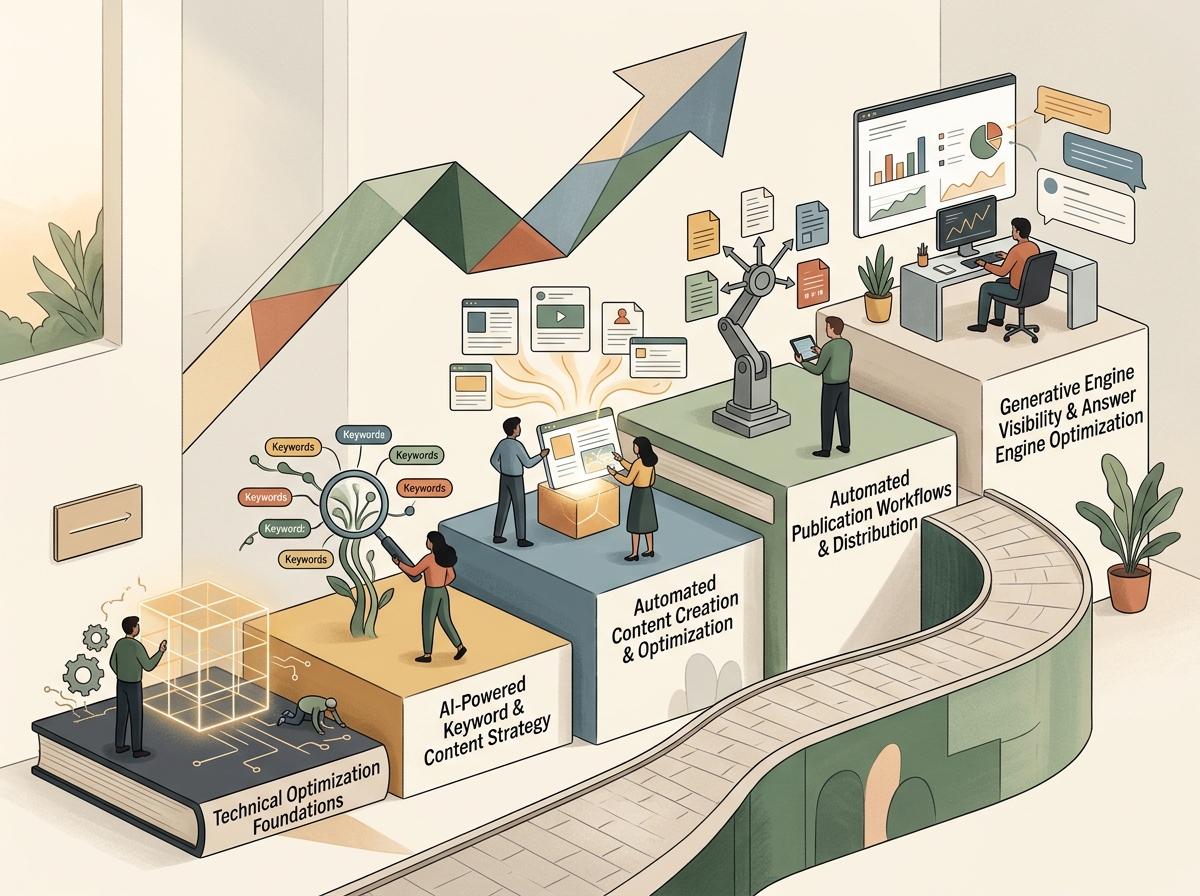
Agency leaders can build a progressive three-tier service catalog:
Base Tier (Search Automation): Includes technical schema implementation, monthly site indexation monitoring, and automated publishing of 15 to 30 targeted articles each month to build baseline topical coverage.
Growth Tier (Topical Dominance): Includes everything in the Base Tier, plus full semantic keyword clustering, intent mapping, quarterly on-page GEO restructuring, and internal linking management.
Enterprise Tier (Full-Spectrum Generative Optimization): Includes everything in the Growth Tier, alongside active third-party digital PR placement, off-page directory governance, and monthly citation benchmarking across major conversational search platforms.
The operational differences between conventional retainers and automated delivery models explain why agency margins improve under this structure:
Comparison Criteria | Traditional Manual SEO Retainers | Automated AI SEO Retainers |
|---|---|---|
Content Production Speed | 2 to 4 articles per month per client due to manual outlining, drafting, and editing. | 15 to 30 articles per month per client through automated generation and rapid human review. |
Third-Party Citation Tracking | Limited to manual backlink audits and standard domain authority metrics. | Continuous audits of conversational search engines to evaluate third-party source citations. |
Cost per Published Article | High labor cost driven by freelance writers, content managers, and manual graphic designers. | Low, predictable software and editor cost, preserving gross margin at scale. |
Scalability for Multiple Clients | Linear scaling: taking on new accounts requires hiring additional writers and editors. | Non-linear scaling: account managers handle multiple publication pipelines inside centralized editors. |
Adopting this operational model reflects recommendations from industry analyses on how to create an SEO strategy to survive the impact of AI, which stress that agencies must combine rapid content delivery with structural machine readiness.
Actionable Implementation Steps for Agencies
Marketing agencies can operationalize these services across their existing client rosters using a systematic rollout schedule:
Conduct a baseline generative citation audit: Select five high-priority clients and query ChatGPT, Perplexity, and Claude using their top commercial product queries. Record whether the clients appear, identify what details are inaccurate, and log the third-party platforms the engines cite.
Deploy foundational schema markup: Audit each client's technical architecture. Add Organization, Service, and Author schema to priority pages to remove ambiguity for crawling systems.
Transition from low-volume blogging to automated velocity: Integrate automated publishing platforms to deliver daily, fully formatted articles. Use existing internal editorial staff to review and adjust tone rather than drafting articles from scratch.
Launch off-page directory governance: Standardize client business data on third-party aggregators and industry review sites, ensuring conversational engines query uniform facts across the web.
Update client reporting dashboards: Add AI search citation presence and topical coverage volume alongside conventional organic traffic reports to demonstrate ongoing retainer value.
Scale client publishing velocity and secure visibility across search engines with Ascend. Ascend learns your client's brand guidelines, targets competitor gaps, generates a 30-day keyword calendar, and publishes daily, fully optimized articles complete with on-brand visuals, internal links, and technical metadata. Agencies can review and refine every post inside an intuitive AI editor to deliver hands-off organic growth.
Written by
Ascend
Ascend is an automated SEO engine for WordPress. It handles keyword research, writes high-quality, search-optimized content, and publishes it directly to your site, so your traffic can grow on autopilot. Learn more